The American Dream: An Expat's Perspective on the Land of Opportunity
After 15 years in Singapore and 18 months in America, I've discovered the American Dream isn't dead—but it's far more complex than the world imagines.
The "American Dream" is something I grew up hearing about in Vietnam, but it always felt abstract — like something from a movie. After living in Singapore for more than 15 years and now being in the US for about 18 months, I think I am starting to understand what it really means — and also what it doesn't mean. I might be wrong about some of this, so take it with a grain of salt :)

What the Dream looked like from Vietnam
Growing up, the American Dream was packaged as a single powerful idea: anyone can achieve success and prosperity through hard work, determination, and a bit of luck. In Vietnam, we had similar beliefs about hard work and perseverance — my parents drilled that into me — but it was never wrapped in a single mythical phrase the way "the American Dream" is.
From the outside looking in, America felt almost magical. People in my extended family who moved to the US sent money back. They seemed to have made it. What I didn't understand then was how much the reality had shifted. The US GDP as a percent of world GDP (using purchasing power parity) has been declining for decades. The dream is still real, but the math around it has changed.
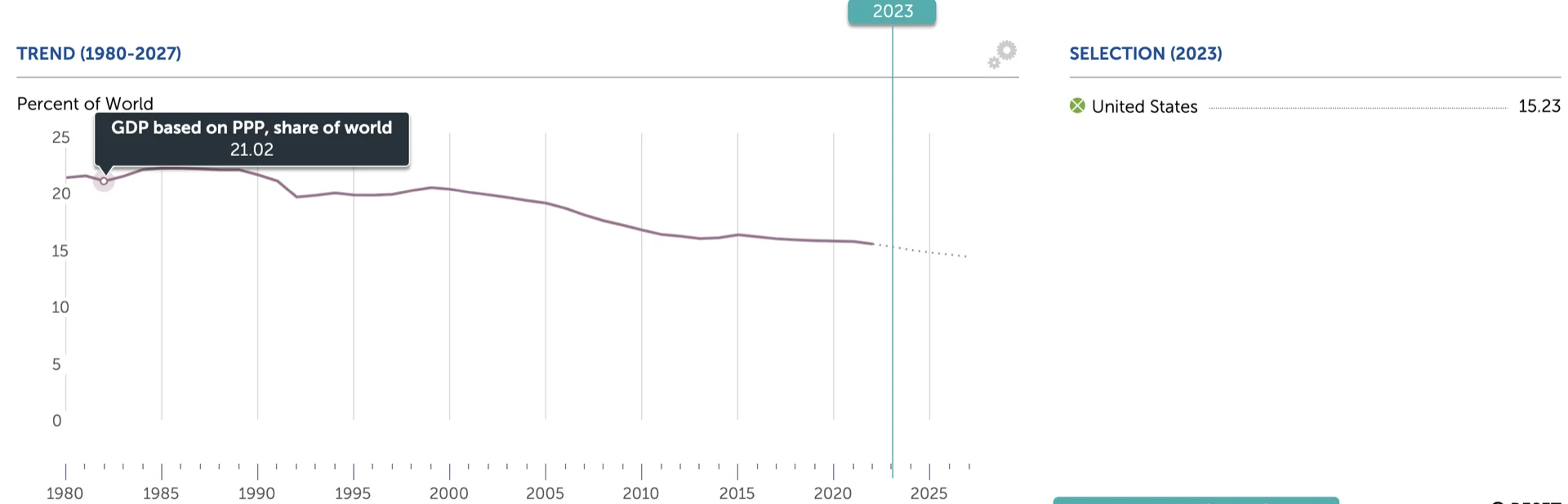
Data from IMF here.
The opportunity is real — but so are the barriers
I have been genuinely inspired by the stories of successful immigrants and expats who have made their mark here. The diversity is real, and it is one of the things I appreciate most about the US. In Singapore, diversity existed too, but the sheer scale here is different — you meet people from every corner of the world in ordinary, everyday situations.
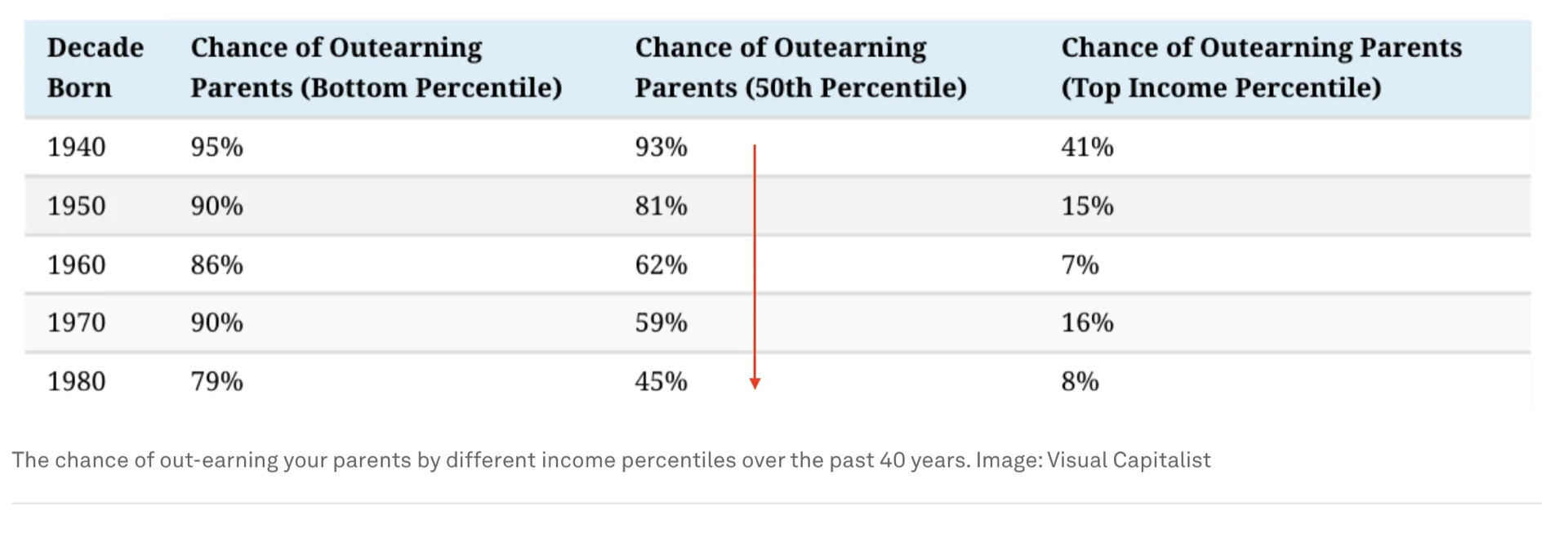
But I would be lying if I said the playing field is level. Studies have shown that upward mobility has declined over the past 40 years. According to research highlighted by the World Economic Forum, "fewer people in the lower- and middle-classes are climbing the economic ladder." That was sobering to read.
For expats like me arriving on a work visa with a decent salary, the experience is fundamentally different from someone who grew up here in a low-income family. I think it is important to acknowledge that.
Education: world-class at the top, wildly uneven everywhere else
Education is often considered a cornerstone of the American Dream. In Vietnam and Singapore, families place enormous value on academic achievement too — so I understood the emphasis. But what surprised me was the variance.
The US is home to world-class universities and research institutions — no argument there. But access to these top schools is highly competitive, and not everyone has an equal shot. More importantly, the quality of K-12 education varies wildly between states and even between counties in the same state. In California alone, with close to 6 million students, the graduation rates and academic achievement levels are all over the map. You can read more here.
This was genuinely shocking to me. In Singapore, the education system is more standardized — you broadly know what you are getting regardless of neighbourhood. Here, your zip code matters a lot.
The entrepreneurial energy is unmatched
One thing that genuinely impressed me: the entrepreneurial spirit. In Singapore and Vietnam, entrepreneurship is celebrated too, but the scale and resources available in the US are on another level. The AI funding from US venture capital alone is staggering — you just do not see that kind of ecosystem in Southeast Asia yet.
I remember attending a tech meetup in San Francisco and being struck by how casually people talked about starting companies. In Asia, the conversation is usually more cautious. Here, failure is almost worn as a badge of honour. I am not saying one approach is better — they are just different. But for people with an entrepreneurial mindset, the US really does offer a unique environment.
So is the Dream still alive?
The American Dream is real, but it is a lot more complex than the world imagines. From my limited experience so far, the opportunity here is genuine — but so are the challenges. Income inequality, healthcare costs, the varying quality of education — these are real hurdles that the mythology glosses over.
I think the key for expats like me is to go in with open eyes, do the research, and not assume that what worked in Asia will work the same way here. The Dream isn't dead — but it has evolved, and it looks different depending on where you are standing.
I am a student in this subject and I have a lot more to learn. What has been your experience with the American Dream — whether you are an expat or not? I would love to hear different perspectives.
Cheers,
Chandler