Expat guide to US relocation: Consider the cost of living
Before you relocate to the US, know this: your cost of living could double or halve depending on where you land—Manhattan costs twice the national average.
Updated for 2026: This post was originally published in 2023. For the latest tips and a comprehensive guide, see Moving to the US as an Expat: The Complete Relocation Guide (2026).
I thought Singapore was expensive. Then I moved to the Bay Area :P
Okay, that's a slight exaggeration — Singapore is genuinely expensive for certain things (cars, alcohol, eating out at Western restaurants). But the overall cost of living in the US, especially in California, hit me harder than I expected. And from talking to other expat friends, I know I'm not alone in this.
If you're planning a move to the US, understanding the cost of living in your target city isn't just helpful — it's essential. The difference between cities can be dramatic, and what feels like a generous salary in one place might barely cover your basics in another.
Costs vary wildly between cities
The US is a continental-sized country with 334+ million people (Census Dec 2022 estimate), so naturally, the cost of living differs enormously. Generally, the East and West Coasts are more expensive than the Midwest or South.
The Council for Community and Economic Research (C2ER) publishes a Cost of Living Index that's been the most consistent source for city comparisons since 1968. Here are the top 10 most and least expensive urban areas from Q3 2022:
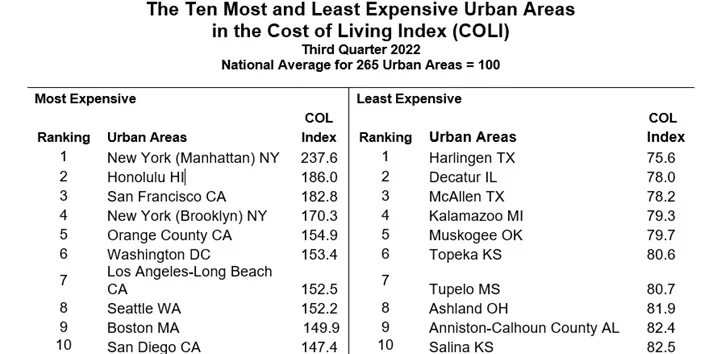
Manhattan is more than twice the national average. San Francisco is 1.8 times. When I first saw these numbers, I realized why my paycheck felt like it evaporated every month.
If you want to do a more detailed comparison, C2ER has a tool here, though there's a fee.
Housing — the biggest line item
This will likely be your single largest expense, and it's where the regional differences are most dramatic. Average rent for a one-bedroom in Manhattan in late 2022 was about $4,000/month. In Indianapolis? Less than $1,000. That's a 4x difference for the same type of apartment.
Coming from Singapore, I thought I was prepared for high rent. I was not fully prepared :) Research the specific city or neighborhood you're targeting and compare it to what you're paying now. It will help you negotiate your relocation package if you're moving for work.
Cars — you'll probably need one
Unlike Singapore (where owning a car is a luxury that costs more than most apartments), cars in the US are practically a necessity outside of a few major cities with good public transit. The cost includes:
- Purchase price — the average new car in November 2022 set a record at over $48,000. Used cars remain elevated too, thanks to pandemic-era supply chain issues :|
- Insurance
- Gas
- Maintenance
If you're coming from Singapore where a car costs SGD 150,000+ with the COE, the sticker prices here might actually look reasonable. But don't forget that in the US, you're also paying for gas, maintenance, and insurance that add up quickly.
Healthcare — budget carefully
I've written a separate deep dive on US healthcare for expats, but the short version: it's expensive and confusing. A family of three in San Francisco might pay $500+ per month just for premiums on a high-deductible employer-sponsored plan, and that's before deductibles and copays.
Compare this to what you're paying in your home country and build it into your budget. Healthcare costs caught me off guard more than almost anything else.
Food and groceries
With inflation near 40-year highs (at the time of writing), grocery bills have been painful. A dozen eggs ran about $3.60 by the end of 2022. A gallon of milk: $4.40. Dining out at a mid-range restaurant: $20-$50 per person, plus tip (usually 15-20%, which is not optional — another culture shock for many expats).
From my experience, cooking at home most nights and saving restaurants for weekends is how most expat families manage the food budget. I miss being able to grab a good $3 chicken rice in Singapore T.T
Entertainment and leisure
Movie tickets, concerts, sports events, gym memberships — these add up. A movie ticket in San Mateo costs about $20. A concert in NYC can easily be $100+. Gym memberships range from $30-$100/month.
I think the key is to figure out what entertainment matters to you and budget for it specifically, rather than trying to maintain the same social calendar you had back home.
Education
If you have kids, this is a big one. Public school is free, which is great. But if you're considering private school, expect $10,000-$30,000+ per year for K-12. University tuition ranges from roughly $30,000/year at a public university in California to $50,000+ at a private university. These numbers still blow my mind.
Taxes
The US tax system is... complex. Some highlights:
- Federal income tax: top rate of 37% for individuals earning over $578,125 (tax year 2023)
- State income tax: varies wildly. Nevada has zero. California's top marginal rate is close to 13%.
- Sales tax varies by state and even by city
Coming from Singapore (where the top personal income tax rate is 22% and there's no capital gains tax), the US tax burden was a significant adjustment for me. Make sure you factor taxes into any salary comparison.
I think the biggest mistake expats make is comparing their current salary to a US offer without accounting for the full cost-of-living picture. A $200,000 salary in San Francisco doesn't stretch the same as $200,000 in Austin, Texas. Do the math before you commit.
What surprised you most about the cost of living after your move? I'd love to hear from other expats about what caught them off guard.
Cheers,
Chandler
P.S. I created a group on Facebook called Asian Expats in the US where we share tips and compare notes. Feel free to join.